Adventures
- March Break Adventure
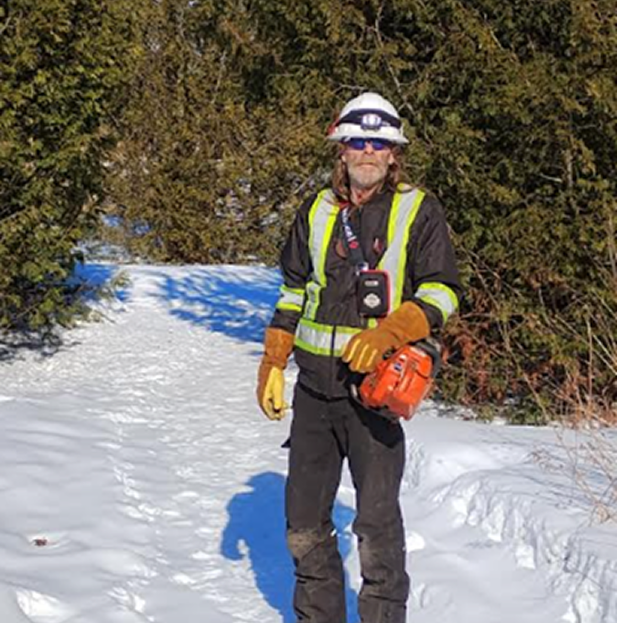
Hosted by Marty D.
- 2026 March 16 – 20 from 9:00 am – 3:00 pm
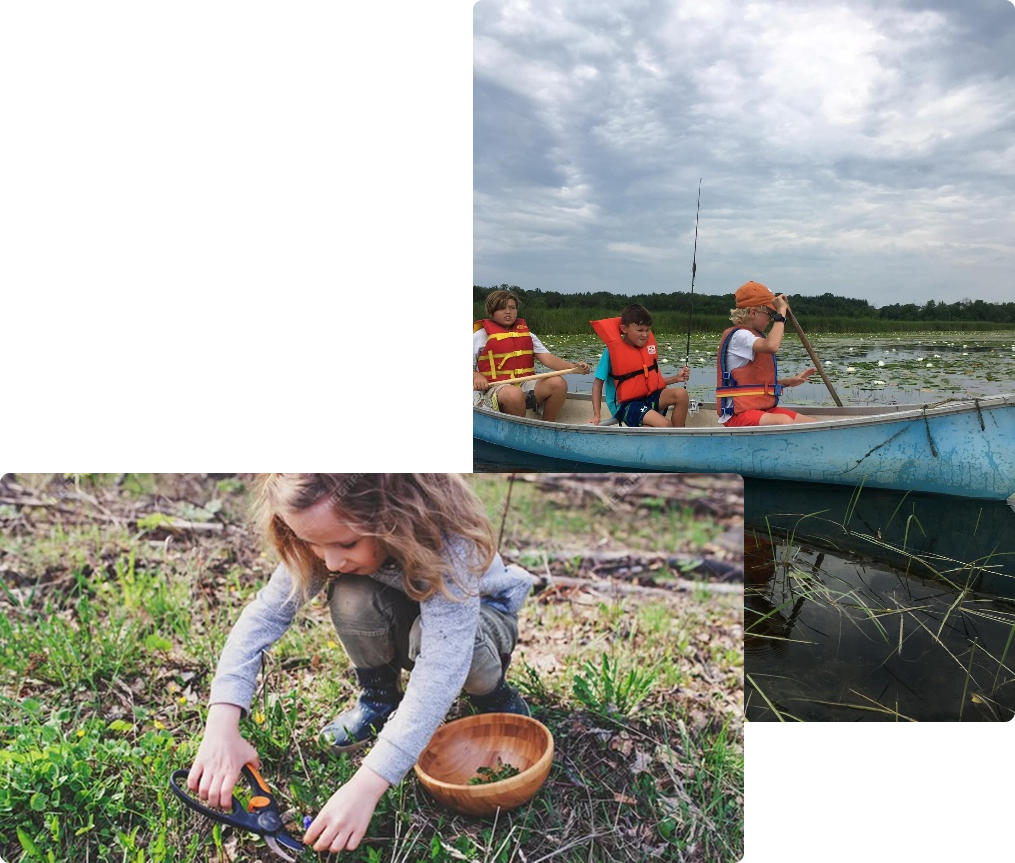
- Don’t let the "mud season" keep you indoors! Our March Break Adventure camp is designed for kids who want to shake off the winter blues, master new tools, and learn how to navigate the changing landscape.
- Each day is a new mission involving teamwork, technology, and old-school survival skills.
- The High-Tech Scavenger Hunt:We’ll use GPS units to track down hidden caches revealed by the melting snow.
- Navigation Challenge:Learn to use a compass even when the trails are covered in mud or slush.
- Spring Survival Skills:How to stay warm and dry in “shoulder season” weather. We’ll practice building emergency shelters using natural materials and learning the basics of fire safety.
- The Green Clean:A special session on the Waterless Car Wash—learning how to keep things clean using eco-friendly methods that don’t waste water during the spring thaw.
- Lyme Awareness:A kid-friendly introduction to identifying ticks as they emerge in the spring and how to stay safe using natural protocols.
- Dates:Monday, March 16th – Friday, March 20th
- Hours:9:00 AM – 3:30 PM (Early drop-off available)
- Ages:Recommended for ages 6–13
- Equipment:We provide the GPS units and compasses. Campers just need to bring waterproof boots and layers!
“There is no such thing as bad weather, only unsuitable clothing!” Our March Break camp celebrates the transition of the seasons, teaching kids that adventure happens year-round.
Recommended gear list: rubber boots, shoes, extra pair of socks, “three layers of warmth”, rain jacket/coat, 2 pairs gloves, to help them prepare for a day outdoors in the spring.
Ready to Sign Up?
- Adventure
Summer Day Camp Adventures
- Camp #1 July 6 – 10
- Camp #2 July 13-17
- Camp #3 July 20-24
- Camp #4 July 27-31
- Igniting curiosity and building confidence through outdoor adventure.
- Led by John D. (Dudley), our summer day camps are designed for young explorers who love to get their hands dirty and learn how the world works. From high-tech treasure hunting to essential survival skills, we offer a summer of discovery.
- The Explorer Series
Turn the great outdoors into a giant treasure hunt! Campers will learn how to use GPS technology and smartphones to locate “hidden caches” in the local area. This camp blends technology with physical activity, teaching kids spatial awareness and the thrill of discovery.
Could you survive in the woods? In this hands-on camp, participants learn the fundamentals of staying safe in nature.
- Skills include:Building emergency shelters, fire safety, water filtration basics, and identifying local edible (and non-edible!) plants.
A classic adventure! Using only a map and a traditional compass, teams will navigate through local trails to find checkpoints. It’s a week of teamwork, problem-solving, and “unplugged” fun.
A vital camp for every young hiker. We teach kids how to enjoy nature safely, including our “Lyme Disease Herbal Protocol” for prevention and what to look for after a day in the brush.
- Bonus Activity:The Waterless Car Wash—a fun, splashy way to learn about water conservation and eco-friendly chemistry!
Why Choose
John D’s Camps?
Safety First
All activities are supervised with a focus on risk assessment and group well-being.
Skill-Based Learning
We don't just "play"—we gain confidence by mastering real-world tools.
Environmental Connection
We foster a deep respect for the land and our local ecosystems.
Safety First
All activities are supervised with a focus on risk assessment and group well-being.
Skill-Based Learning
We don't just "play"—we gain confidence by mastering real-world tools.
Environmental Connection
We foster a deep respect for the land and our local ecosystems.
Camp Details at a Glance
|
Feature
|
Information
|
|---|---|
|
Ages
|
6–12 (Split into Junior and Senior groups if possible)
|
|
Location
|
Gamiing Nature Centre
|
|
Time
|
9:00 AM – 3:30 PM (Monday – Friday)
|
|
What to Bring
|
See Information and Registration package
|
For Kids' Camps (March Break & Summer)
Adventurous hikes
- Gear: We provide the GPS units and compasses!
- Packing List: Please send your camper with a refillable water bottle, a nut-free lunch, sunblock, and a hat
- (click here for dates and times)
- Moon Name Meanings
- Wolf Moon (Jan):Named for the hungry wolves that howled outside villages during the midwinter cold.
- Snow Moon (Feb):Typically the month of the heaviest snowfall in the Northern Hemisphere.
- Worm Moon (March):Named for the earthworm casts that appear as the ground begins to thaw for spring.
- Pink Moon (April):Named after the “moss pink” (wild ground phlox), one of the earliest widespread flowers of spring.
- Flower Moon (May):Symbolizes the abundance of flowers in full bloom during late spring.
- Blue Moon (May 31):The second full moon in a single calendar month (a “Monthly Blue Moon”).
- Strawberry Moon (June):Named by indigenous North American tribes to signal the time for gathering ripening strawberries.
- Buck Moon (July):This is the time of year when new antlers of buck deer push out of their foreheads in velvety fur.
- Sturgeon Moon (Aug):Named for the large fish that were most readily caught in the Great Lakes during this month.
- Corn Moon (Sept):Also known as the Harvest Moon, this marks the time when crops are gathered before the first frost.
- Hunter’s Moon (Oct):Named for the time when leaves have fallen and deer are fattened, signaling the time to hunt for winter meat.
- Beaver Moon (Nov):Named for the time when beavers finish their winter dams and humans traditionally set traps before the water freezes.
- Cold Moon (Dec):A simple name for the month when the winter cold fastens its grip and the nights are longest.
The 13 Moons of the Anishinaabe Year
|
English Month
|
Anishinaabe Moon Name
|
Meaning & Garden Connection
|
|---|---|---|
|
January
|
Gichi-manidoo-giizis
|
Great Spirit Moon: A time for silence and winter dreams.
|
|
February
|
Namebini-giizis
|
Sucker Fish Moon: When the fish begin to move under the ice.
|
|
March
|
Onaabani-giizis
|
Hard Crust on the Snow Moon: Best time for maple tapping.
|
|
April
|
Iskigamizige-giizis
|
Maple Sap Boiling Moon: The first "gift" of the trees.
|
|
May
|
Waabigwani-giizis
|
Flower Moon: Time to plant the Three Sisters.
|
|
June
|
Ode’imini-giizis
|
Heart Berry Moon: The time for Wild Strawberries!
|
|
July
|
Aabita-niibino-giizis
|
Halfway Through Summer Moon: High growth in the garden.
|
|
August
|
Manoominike-giizis
|
Ricing Moon: When the wild rice in the Kawarthas ripens.
|
|
September
|
Waatebagaa-giizis
|
Leaves Turning Color Moon: The garden begins its slow "thank you."
|
|
October
|
Binaakwi-giizis
|
Falling Leaves Moon: Time to mulch and protect the soil.
|
|
November
|
JulyaGashkadino-giizis
|
Freezing Moon: The Earth prepares for its long sleep.
|
|
December
|
Manidoo-giizisoons
|
Little Spirit Moon: A time for storytelling and rest.
|
|
13th Moon
|
Mnidoons-giizis
|
Big Spirit Moon: Used to keep the lunar and solar years aligned.
|
Seasonal Interpretive Walks
Beyond the Leaves
How do you tell a Sugar Maple from a Silver Maple before the leaves appear? What makes a White Pine “the Tree of Peace”? Join us at Gamiing Nature Centre for an interactive walk through our 100-acre forest as we learn the secrets of tree identification.
This walk is designed for those who want to look at the forest and see individuals, not just a “wall of green.”
🔍 What You’ll Learn to Spot
In the early spring, we focus on the “Big Three” of tree identification:
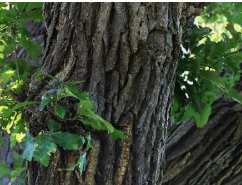
- The Bark:From the “burnt cornflakes” bark of the Black Cherry to the “shaggy” strips of the Shagbark Hickory.
- The Buds:We’ll look at the sharp, “cigar-shaped” buds of the Beech and the “praying hands” of the Flowering Dogwood.
- The Branching:Learn the “MAD Horse” trick! (Maple, Ash, Dogwood, and Horse Chestnut) are the only local trees with opposite Everything else is alternate.
🌲 Gamiing’s “Legacy Trees”
During our walk, we will pay special visits to some of the most important residents of our property:
- The Towering White Pines:The majestic giants that line our shoreline.
- The Ironwood:Also known as “Musclewood” for its incredibly hard, ripple-textured bark.
- The Yellow Birch:Look for the silvery-yellow peeling bark that smells like wintergreen when scratched.
- The Cedar Groves:Exploring the quiet, cool microclimates created by our dense Eastern White Cedars.
🎒 What to Bring
- A Camera:To snap photos of buds and bark for your own reference library.
- The “Tree Book”:If you have a favorite field guide (like Lone Pine or Peterson’s), bring it along!
- Appropriate Footwear:We’ll be heading off the main Lakeview Trail into some of the woodlot areas.
📍 Event Details
- Date:[Insert Date and time] or clickable
- Guide:
- Focus:Silviculture, Ecology, and Stewardship.
- Did you know?Many of the trees at Gamiing have been standing since long before the Nature Centre was founded. We walk among elders!
Want to bring a memory of Gamiing’s forest home? Planting a native tree is the best gift you can give to future generations and local wildlife. Find a landscaper in your area who sells native trees.
- The Golden Rule: Right Tree, Right Place
Before you dig, look up and look around.
- Sunlight:Does the spot get 6+ hours of sun (White Oak) or is it shaded (Sugar Maple)?
- Soil:Is it “wet feet” territory (White Cedar/Larch) or dry and rocky (Red Pine)?
- Space:Remember, that 2-foot sapling might become a 60-foot giant. Give it room to grow away from power lines and foundations.
- The “Gamiing Approved” Native List
We always recommend planting species native to the Kawarthas. They are hardier, require less water once established, and support our local birds and pollinators.
- For Birds:White Spruce or Serviceberry.
- For Fall Color:Sugar Maple or Red Oak.
- For Fast Privacy:Eastern White Cedar.
- For the Pollinators:Basswood (the “Bee Tree”) or Willow.
- How to Plant Like a Pro
Follow these steps to give your tree the best start:
- The Hole:Dig it twice as wide as the root ball, but no deeper. You want the “root flare” (where the trunk widens at the base) to be exactly at ground level.
- The “Tickle”:If the roots are circling the pot (root-bound), gently tease them outward so they don’t strangle the tree later.
- The Fill:Use the same soil you dug out. Avoid “heavy” store-bought fertilizers right away—let the tree get used to the natural soil.
- The “Mulch Donut”:Apply 2-3 inches of wood chips around the base, but keep it away from the trunk. It should look like a donut, not a volcano! This keeps moisture in and weeds out.
- The First Year: Water, Water, Water!
Your new tree is thirsty. For the first two growing seasons, give it a deep soak once a week (more during Kawartha summer droughts). A slow trickle for 20 minutes is better than a quick splash.
For available dates, click here
Winter is finally receding from the shores of Pigeon Lake. As the sap begins to flow and the red-winged blackbirds return to the marshes, we invite you to join us for our inaugural spring trek.
At Gamiing, spring isn’t just a season; it’s a transformation. We’ll be moving at a mindful pace, observing the first signs of life in the tallgrass prairies and the soft budding of the forest canopy. Whether you are a seasoned naturalist or just looking to reconnect with the earth, there is a place for you on our trails.
Nature is in charge during the shoulder season! To ensure you have the best experience at Gamiing, please keep the following in mind:
- The Mud Factor:Our trails are vibrant and wild, which means they can get quite soft and “soupy” in the spring. We highly recommend sturdy, waterproof hiking boots.
- Shoreline Breezes:It may feel like t-shirt weather in town, but the breeze off Pigeon Lake can be significantly cooler. Bring a windbreaker or a light fleece just in case.
- Wildlife Etiquette:This is a sensitive time for nesting birds and emerging amphibians. We ask that all hikers stay strictly on the marked Trails to protect the delicate new growth and habitats.
- Variable Conditions:If we encounter heavy rain or high winds, check our social media or this page two hours before the hike for any postponement updates.
As the wetlands thaw, keep your eyes peeled for Painted Turtles basking on logs and the first “peeps” of Spring Peepers. We encourage you to bring binoculars and a camera, but remember: take only photos, leave only footprints.
Join the First Spring Hike
Please fill out the form below and email it to info@gamiing.org, to help us manage group sizes and ensure everyone stays safe on the trails.
Hike Date: [Insert Date] | Time: [Insert Time]
Location: Gamiing Nature Centre: Gather at the parking lot.
- Name:[Text Box]
- Email Address:[Text Box]
- Number of Hikers in Your Party:[Dropdown 1-10]
- Emergency Contact Number:[Text Box]
- Experience Level:* ( ) Beginner (I’m here for the views!)
- ( ) Intermediate (I hike occasionally)
- ( ) Advanced (Show me the challenging terrain)
- Special Requirements:(e.g., “Bringing a leashed dog,” “Bringing a stroller”) [Text Area]
- Waiver:* [ ] I understand that spring trails may be muddy or slippery and I am responsible for wearing appropriate footwear.
“Our First Spring Hike is a ‘Pay-What-You-Can’ event. All donations go directly toward trail maintenance and habitat restoration for our resident turtles and birds.”
Four weeks later, in late April to mid May, the landscape at Gamiing transforms completely. The “brown” of early spring turns into a vibrant, electric green, and the Spring Ephemerals (flowers that bloom and disappear quickly) start to carpet the forest floor.
If you joined us for our first trek, you won’t believe the transformation. In just one month, Gamiing has woken up! The mud is drying, the canopy is leafing out, and the forest floor is racing to bloom before the shade sets in.
Join us for our Mid-Spring Discovery Hike as we witness the peak of the “Green-Up.” This hike is all about the details—the tiny flowers, the returning songbirds, and the bustling activity of the wetlands.
What’s Changed? (The 4-Week Difference)
At Gamiing, a lot happens in thirty days. Here is what we’ll be looking for on this second outing:
- The Flower Rush:Look for Trilliums (Ontario’s star!), Trout Lilies, and Dutchman’s Breeches. These “ephemerals” only last a few weeks—don’t miss them!
- The Songbird Symphony:The woods are much louder now. Warblers and Baltimore Orioles are arriving back from their long journeys.
- Turtle Suntanning:With warmer sun, the logs along the shoreline and marshes will be crowded with Painted and Snapping turtles.
- Drier Trails:While there might be a few soft spots, the “rubber boot” season is mostly behind us. Sturdy hiking shoes or trail runners are usually perfect now.
Updated Packing List: Mid-Spring
- Binoculars:A must for spotting the colorful migratory birds in the budding trees.
- Magnifying Glass:To get a closer look at the intricate spring wildflowers.
- Bug Mesh/Repellent:The blackflies might be starting their first “scouting missions”—be prepared!
- Light Layers:It’s getting warmer, but the breeze off Pigeon Lake can still be brisk.
- Focus:Botany, Birding, and Biodiversity.
- Suggested Donation:$20 (Supports our Milkweed planting initiatives!)
- “Spring Progress” Gallery
At Gamiing, the forest floor turns into a literal carpet of color during those four weeks. Here is a Spring Wildflower Guide (click here) and some
Photography Tips (click here) tailored for your Nature Centre visitors.
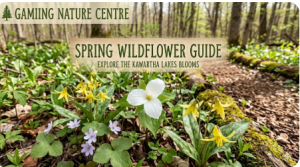
Catch these “Spring Ephemerals” before the forest canopy closes!
The Early Risers (March – Mid-April)
These hardy species often brave the last of the snow to signal the start of the season.
- Skunk Cabbage(Symplocarpus foetidus)
- Where to find it:The wet, mucky areas near the Frog Pond or Turtle Bay
- ID Tip:Look for a mottled, maroon shell (spathe) poking through the mud. It actually generates heat to melt the snow around it!
- Sharp-lobed Hepatica(Anemone acutiloba)
- Where to find it:Open edges of the deciduous forest.
- ID Tip:Delicate white, pink, or lavender flowers with fuzzy stems. Its leaves have three pointed lobes (like a liver, hence the name “Liverleaf”).
- Coltsfoot(Tussilago farfara)
- Where to find it:Often found in the gravelly or disturbed soil near the trailheads.
- ID Tip:Bright yellow flowers that look like small dandelions but appear on scaly stems before any leaves grow.
The Mid-Spring Blanket (Late April – Mid-May)
This is the “peak” season where the forest floor at Gamiing transforms into a sea of colour.
- Yellow Trout Lily(Erythronium americanum)
- Where to find it:Massive colonies along the Cedar Grove Trail.
- ID Tip:Look for nodding yellow flowers and leaves mottled with brown/purple spots, resembling the skin of a Brook Trout.
- White Trillium(Trillium grandiflorum)
- Where to find it:Shaded sugar maple stands.
- ID Tip:Ontario’s provincial flower. Three white petals that turn a soft pink as they age. Reminder: Please don’t pick! It can take 7–10 years for a trillium to bloom for the first time.
- Bloodroot(Sanguinaria canadensis)
- Where to find it:Well-drained soil along the Glacier Trail.
- ID Tip:A single, pure white flower with a golden center, usually wrapped in a unique, scalloped leaf. It gets its name from the bright red sap in its roots.
The Late Spring Wonders (Late May – June)
As the trees leaf out, these unique blooms take center stage.
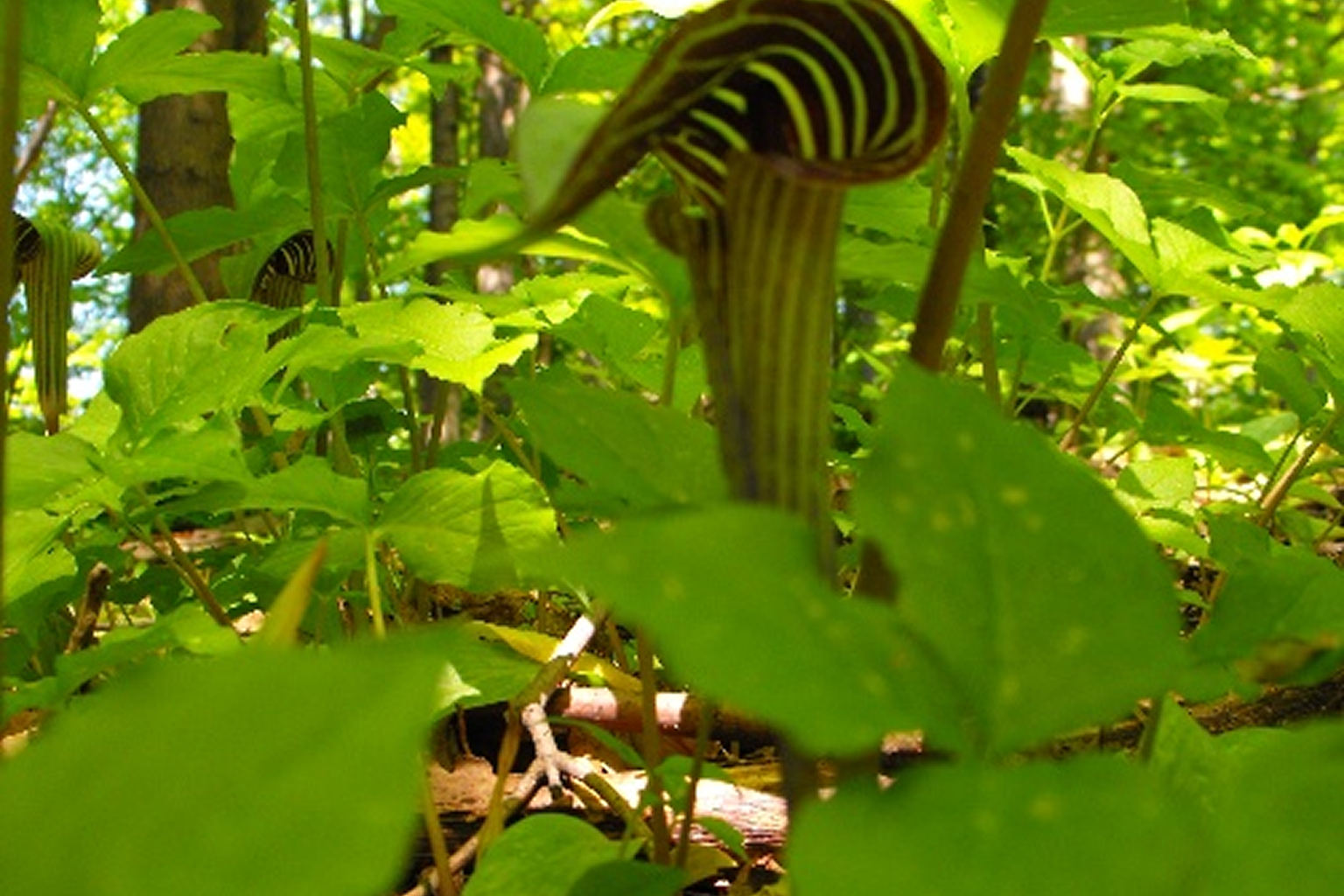
- Jack-in-the-Pulpit(Arisaema triphyllum)
- Where to find it:Moist, wooded areas near the Beaver Trail.
- ID Tip:A striped green-and-maroon “hood” (the pulpit) with a small spike (Jack) inside.
- Mayapple(Podophyllum peltatum)
- Where to find it:Understory of the Cedar Grove sugar maple stand.
- ID Tip:Large green leaves that look like tiny umbrellas. A single white flower hides underneath the leaves—you have to crouch down to see it!
- Dutchman’s Breeches(Dicentra cucullaria)
- Where to find it:Rocky, rich soil.
- ID Tip:Fragile white flowers that look exactly like a pair of puffy white trousers hanging upside down on a clothesline.
Visitor “Rules of the Trail”
- Stay on the Path:Many of these flowers (like the Trout Lily) grow in huge colonies from a single underground bulb. Stepping on the leaves can kill the entire colony.
- Photography Only:Picking wildflowers prevents them from seeding for next year and can harm the local pollinators.
- Citizen Science:Share your finds! Tag @GamiingNatureCentre on social media or upload your photos to the iNaturalist app to help us track our biodiversity.
Healing from the Land
For thousands of years, the land around Pigeon Lake has provided more than just scenery—it has provided health. Join us for a specialized walk where we explore the traditional and herbal uses of the plants found right here at Gamiing.
This isn’t just a hike; it’s a lesson in “The Honorable Harvest.” We’ll discuss how to identify beneficial plants, their historical uses in the Kawarthas, and the ethics of gathering from the wild.
🌱 What We’ll Explore
Spring is when the “living medicines” are most potent. On this walk, we will focus on:
- Cedar (Giizhik):Known as a powerful purifier and a source of Vitamin C. We’ll discuss its role as a “protector” in the forest.
- White Pine:Learn how the needles and inner bark were traditionally used for respiratory health and healing balms.
- Mullein:Often called “Nature’s Flannel,” we’ll look for the soft rosettes and discuss their traditional use for soothing coughs.
- Red Osier Dogwood:Recognizable by its bright red stems, this plant has a deep history of both medicinal and craft use.
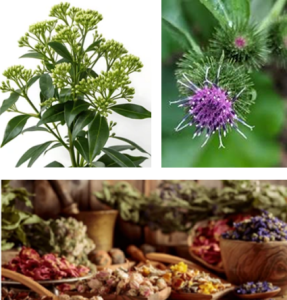
- Dandelion & Burdock:The “Spring Detox” plants. We’ll talk about how these “weeds” support liver and digestive health.
⚖️ The Ethics of Stewardship (The “Gamiing Way”)
At Gamiing Nature Centre, our first priority is the health of the ecosystem. During this walk, we emphasize:
- Identification First:Never use a plant unless you are 100% certain of its identity.
- The 1-in-10 Rule:We teach the ethics of never taking more than nature can spare.
- Respecting the “Grandparents”:We leave the oldest, strongest plants to continue their work in the forest.
- Sanctuary Rules:Please note that harvesting is not permitted during the walk. We are here to learn and observe so that you can apply these principles in your own garden or sustainable plots.
📍 Event Details
- Date:[Insert Date]
- Facilitator:[Name of Guide/Naturalist]
- What to Bring:A notebook, a camera, and an open mind.
- Suggested Donation:$25 (Supports our Indigenous Knowledge programming and trail upkeep).
Disclaimer: This walk is for educational purposes only. Always consult with a healthcare professional or a trained herbalist before using any plant medicinally.
The Great Green-Up: Our Second Spring Hike
Four weeks later, in late April to mid May, the landscape at Gamiing transforms completely. The “brown” of early spring turns into a vibrant, electric green, and the Spring Ephemerals (flowers that bloom and disappear quickly) start to carpet the forest floor.
If you joined us for our first trek, you won’t believe the transformation. In just one month, Gamiing has woken up! The mud is drying, the canopy is leafing out, and the forest floor is racing to bloom before the shade sets in.
Join us for our Mid-Spring Discovery Hike as we witness the peak of the “Green-Up.” This hike is all about the details—the tiny flowers, the returning songbirds, and the bustling activity of the wetlands.
What’s Changed? (The 4-Week Difference)
At Gamiing, a lot happens in thirty days. Here is what we’ll be looking for on this second outing:
- The Flower Rush:Look for Trilliums (Ontario’s star!), Trout Lilies, and Dutchman’s Breeches. These “ephemerals” only last a few weeks—don’t miss them!
- The Songbird Symphony:The woods are much louder now. Warblers and Baltimore Orioles are arriving back from their long journeys.
- Turtle Suntanning:With warmer sun, the logs along the shoreline and marshes will be crowded with Painted and Snapping turtles.
- Drier Trails:While there might be a few soft spots, the “rubber boot” season is mostly behind us. Sturdy hiking shoes or trail runners are usually perfect now.
Updated Packing List: Mid-Spring
- Binoculars:A must for spotting the colorful migratory birds in the budding trees.
- Magnifying Glass:To get a closer look at the intricate spring wildflowers.
- Bug Mesh/Repellent:The blackflies might be starting their first “scouting missions”—be prepared!
- Light Layers:It’s getting warmer, but the breeze off Pigeon Lake can still be brisk.
- Focus:Botany, Birding, and Biodiversity.
- Suggested Donation:$20 (Supports our Milkweed planting initiatives!)
- “Spring Progress” Gallery
At Gamiing, the forest floor turns into a literal carpet of color during those four weeks. Here is a Spring Wildflower Guide (click here) and some
Photography Tips (click here) tailored for your Nature Centre visitors.
Healing from the Land
For thousands of years, the land around Pigeon Lake has provided more than just scenery—it has provided health. Join us for a specialized walk where we explore the traditional and herbal uses of the plants found right here at Gamiing.
This isn’t just a hike; it’s a lesson in “The Honorable Harvest.” We’ll discuss how to identify beneficial plants, their historical uses in the Kawarthas, and the ethics of gathering from the wild.
What We’ll Explore
Spring is when the “living medicines” are most potent. On this walk, we will focus on:
- Cedar (Giizhik):Known as a powerful purifier and a source of Vitamin C. We’ll discuss its role as a “protector” in the forest.
- White Pine:Learn how the needles and inner bark were traditionally used for respiratory health and healing balms.
- Mullein:Often called “Nature’s Flannel,” we’ll look for the soft rosettes and discuss their traditional use for soothing coughs.
- Red Osier Dogwood:Recognizable by its bright red stems, this plant has a deep history of both medicinal and craft use.
- Dandelion & Burdock:The “Spring Detox” plants. We’ll talk about how these “weeds” support liver and digestive health.
The Ethics of Stewardship (The “Gamiing Way”)
At Gamiing Nature Centre, our first priority is the health of the ecosystem. During this walk, we emphasize:
- Identification First:Never use a plant unless you are 100% certain of its identity.
- The 1-in-10 Rule:We teach the ethics of never taking more than nature can spare.
- Respecting the “Grandparents”:We leave the oldest, strongest plants to continue their work in the forest.
- Sanctuary Rules:Please note that harvesting is not permitted during the walk. We are here to learn and observe so that you can apply these principles in your own garden or sustainable plots.
Event Details
- Date:[Insert Date]
- Facilitator:[Name of Guide/Naturalist]
- What to Bring:A notebook, a camera, and an open mind.
- Suggested Donation:$25 (Supports our Indigenous Knowledge programming and trail upkeep).
Disclaimer: This walk is for educational purposes only. Always consult with a healthcare professional or a trained herbalist before using any plant medicinally.
An "Interactive" Feature
Test Your Knowledge